
"China coffee regions"
5000 article(s) found

Starbucks has expanded its stores by 70% in the past five years, hitting China's local coffee brands.
Full of confidence in the Chinese market, China's annual economic growth (GDP) fell to 6.9% in 2015 from 7.3% the previous year, the lowest level in 25 years. It is an indisputable fact that China's economic growth is slowing. However, Starbucks CEO Howard Schultz announced more than once that the company's market size in China will surpass that of the United States to become the world's largest market in the future.

FHC China Import Food and Hotel equipment Professional Exhibition came to a successful conclusion
Many food and alcohol fairs are held in China every year, but only the FHC imported Food and Hotel equipment Exhibition can be so successful and professional. Only in FHC, you can see that exhibitors and visitors are professional. This was verified at the Shanghai FHC held on November 13-15 last week. The exhibition was well received by both exhibitors and visitors. From 70 countries

GouBuLi is going to open a coffee chain and open 200 new stores in the next five years.
Tianjin GouBuLi Group, a Chinese time-honored brand with a history of more than 150 years, announced yesterday that it had successfully won the permanent right to use Colorado, Australia's largest coffee chain, in China. This means that GouBuLi has become the owner of this well-known international brand in the Chinese market and a sharp weapon for GouBuLi to expand China's local catering market. Zhang Yansen, chairman of Tianjin Goubuli Group, said that the enterprise
Coffee Brand-Costa Coffee challenges Starbucks
CostaCoffee, the UK's largest coffee chain, officially opened its 100th store in China at Terminal T3 of Beijing Capital International Airport, a prime location that was once Starbucks' most profitable store in northern China. This is not the first time Costa has competed head-on with Starbucks. Since Costa entered China in 2008, the competitive goal has been directed at

The more Starbucks, the more dynamic the city! What is the logic behind this?
Professional barista communication Please follow the coffee workshop (official Wechat account cafe_style) 10:00 in the morning is the time when many office workers arrive at the office. The flow of people in the three chain coffee shops in an office building on Chaoyangmen Street is very different: there are few queues in COST an and Maoshou Coffee Shop, and you can buy a cup of take-away coffee in 5 minutes, while the queue at Starbucks next door is crowded to buy one.
World famous Coffee Competition-- World Brista Competition
The World Barista (barista) Competition is a competition of the world's top professional baristas jointly sponsored by the American Professional Coffee Association and the European Professional Association. it began in 2000 and has about 50 member countries. this international competition, held every year in different host cities, attracts baristas from more than 45 countries around the world. All baristas are champions of their national divisions.

Asian Coffee Association huge Chinese Coffee consumption Market Asian Coffee system
Professional coffee knowledge exchange more coffee bean information please follow the coffee workshop (Wechat official account cafe_style) the Asian Coffee Association is a regional coffee industry organization established in 2015 by more than 20 Asian countries, including China, Vietnam and Thailand, with the aim of establishing Asian coffee standards and establishing an Asian coffee price system. Asia is the region with the fastest growing coffee consumption in the world

The 7th (Shanghai) International High-end Food and Beverage Exhibition in 2016
2016 7th (Shanghai) International High-end Food and Beverage Exhibition 2016 the 7th (Shanghai) nternational high-end food and beverage exhibition Exhibition time: June 14-16, 2016 Exhibition address: Shanghai New International Expo Center (2345 Longyang Road) approved by: Shanghai Commerce Commission organizer: China Hotel Association.

Starbucks vision of operating more than 5000 Starbucks stores in the mainland of China by 2021
In mainland China, Starbucks also implements franchisee model in different regions. For example, Unification Group, which first helped Starbucks enter Taiwan, currently owns more than 700 Starbucks stores in Jiangsu, Zhejiang and Shanghai. As for Cai Delin, he needs to continue to enhance the customer experience in Starbucks stores and lead innovation in food and operating systems. In his previous job, he did
Summary of coffee knowledge!
Introduction: maturity is not the aging of the heart, but tears in the eyes, but also can keep smiling. The pleasure of coffee lies in its taste, utility and atmosphere. More and more people choose coffee to accompany themselves to spend a lot of cozy time. Just made coffee, send out this rich fragrance, that kind of attractive aroma, fresh and intoxicating. After getting up in the morning, have a drink to wake up and work during the day.

After stepping down as CEO of Starbucks, Howard went to China to deal with the impact of e-commerce on the high-end market.
This time in China, Howard Schultz brought two gifts to this potential market, one for employees and one for the market on April 11, 2017 in Beijing. Starbucks founder Howard Schultz and Professor Qian Yingyi, dean of Tsinghua School of Economics and Management, clinked their cups with Starbucks' iconic coffee cups. Every reporter Wu Linjing, every editor Chen Junjie, Howard Schultz, the father of Starbucks
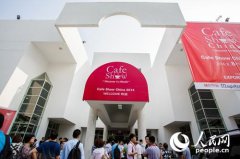
2014 China International Coffee Exhibition held in Beijing
2014 China International Coffee Exhibition held in Beijing 2014 China International Coffee Exhibition (Cafe Show China 2014) was held at Beijing Sanyuanqiao National Exhibition Center from August 8 to 10, jointly sponsored by China Exhibition Group Beijing Huagang Exhibition Co., Ltd. CIEC and South Korea EXPORUM Co., Ltd. The exhibition area of this year's coffee exhibition is nearly double that of the previous one, with more than 120 exhibits from 15 countries and regions.

Global Coffee producing area-the characteristics of Chinese Coffee
Coffee trees are also planted in China. However, since there are no production statistics, no one knows for sure how many coffee trees there are in China and how much coffee they can produce. Coffee producing areas in China: at present, gourmet coffee has been successfully grown in Taiwan, Yunnan and Hainan, which shows that the coffee industry can prosper in the region for a long time. The characteristics of Chinese coffee: flavor: affected by
The contestants of the China trials of the World Barista Competition [Beijing] have signed up!
2015 World baristas Competition (WBC) entry conditions: 1. Coffee lovers with Chinese nationality over the age of 18; 2. Engaged in barista work for more than 2 years, proficient in the use of semi-automatic coffee machine; 3. The number of contestants registered in the same work unit shall not exceed 3 (including 3). The official seal on the application form shall prevail. Where is the business license of the contestants who signed up for each division competition?
Starbucks plans to rapidly expand stores in China to speed up "local transformation and development"
As a global chain, Starbucks now has a market capitalization of 553.1 billion yuan. In the fourth quarter of last year, Starbucks' global profits hit a record high, with global store sales up 8%. Of this total, store sales in China and the Asia-Pacific region increased by 6%. The number of white-collar workers in China has grown rapidly in recent years, which is also the main consumer group of Starbucks operating in China. In the process of China's economic transformation

The characteristics of Yunnan coffee in China Starbucks and Yunnan coffee story
Coffee from Yunnan Province in China is known for its low consistency and fruity flavor and has become an important ingredient in European Arabica blends. Its light taste and aroma are somewhat similar to coffee beans from Honduras or Guatemala. Nestle coffee china agricultural services team director wu ted smite said. Coffee is more profitable than other crops. As a result, more and more Yunnan farmers
Starbucks is protested by Chinese people that coffee is more expensive than abroad in the Chinese market.
The scene caused Chinese people to complain, but Starbucks responded, saying that they were valuable in China. According to the description of the relevant media, Miss Zhu ordered a small latte in the United States with a list price of $2.75. After adding about 8% consumption tax, Miss Zhu paid a total of about $3, equivalent to 18 yuan, while in a Starbucks store in Shanghai, a small cup of latte label

Is there really a trillion-dollar coffee market in China? Three great opportunities for the coffee market in the future!
Professional coffee knowledge exchange More coffee bean information Please pay attention to coffee workshop (Weixin Official Accounts cafe_style) interpretation: At present, the coffee market scale in China is about 110 billion yuan, far away from the total market volume of 1 trillion yuan. In response to the old saying, there is a long way to go for the take-off of China's coffee market. China's coffee market is big enough and profitable enough

High-quality boutique coffee Panamanian coffee flavor taste manor production area characteristics of boutique coffee beans introduction
The Panama Canal is under the de facto control of the United States and will be affected by war and domestic politics. As the only transcontinental canal in Central America, it is not safe. Hong Yuan believes that the excavation of the Nicaraguan Canal will enable two-lane shipping in the region, speed up the flow of logistics and manpower, shorten waterways, reduce shipping costs, and play a balancing role. As a maritime hegemony, the United States

Which beans should be recommended by China Coffee Network? Guava Plain, the New Oriental region of Guatemala
Here in Guatemala, the extra-hard coffee beans are full-grained, delicious and balanced, and the coffee made with them is pure and rich. Guatemala coffee once enjoyed a reputation as the best quality coffee in the world, but its quality also declined for a time. What is gratifying, however, is that its reputation is gradually being restored. In 1750, Father Jesuit introduced coffee trees to Guatemala.